Thursday, June 28, 2018

Corporate Bond Issuance Decelerates to Its Slowest Pace This Year

LISTEN TO ARTICLE 1:43 SHARE THIS ARTICLE Facebook Twitter LinkedIn Email

Sales of investment-grade U.S. corporate bonds are on pace for the slowest week of the year as a flood of debt last week and trade tensions cool demand.

High-grade bond issuance is so far just 6 percent of the low-end projection of $15 billion for the week, and headed for the smallest amount since December, according to data compiled by Bloomberg. No borrowers stepped up on Monday or Wednesday, and Charter Communications Inc. was the only name to announce a deal Thursday.

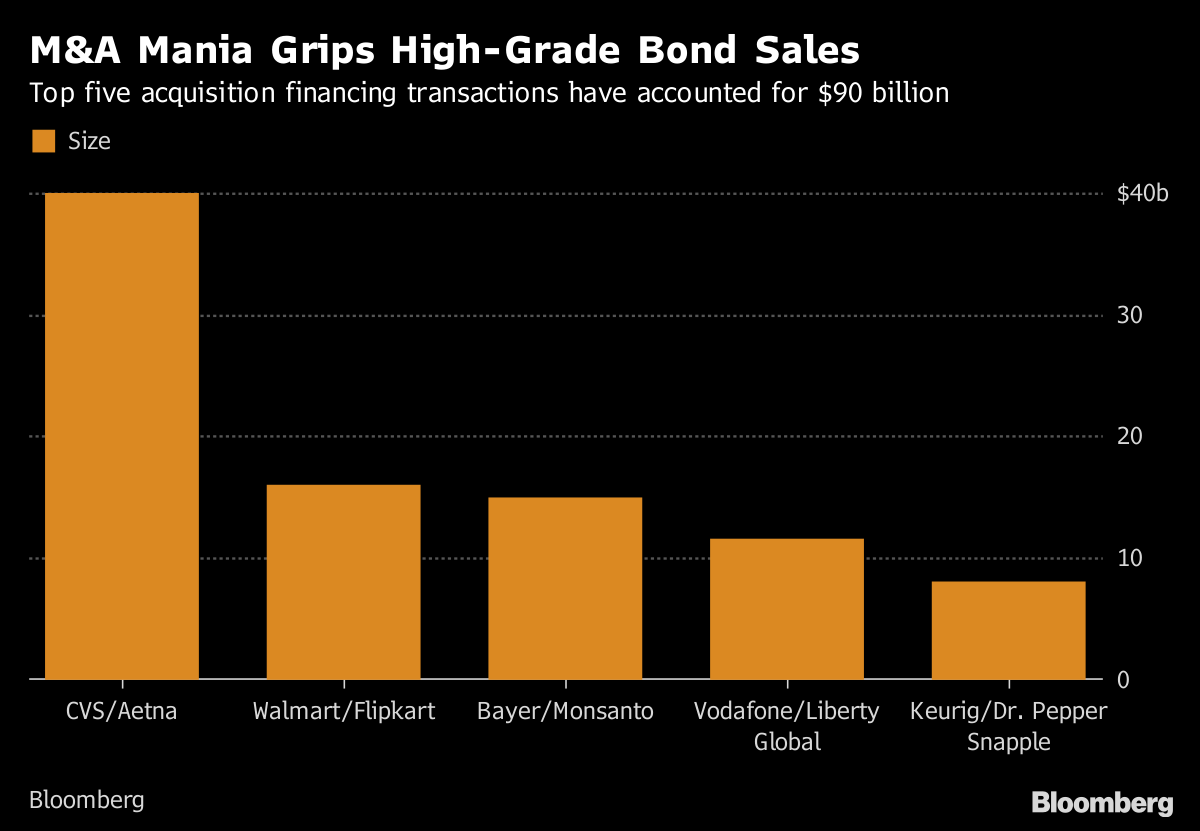
The falloff in sales is more than just summer doldrums. Last week deals from Walmart Inc. and Bayer AG helped boost total issuance to the most since March at $44 billion. Trade tensions have also pushed investors to the safety of Treasuries, driving the 10-year yield to the lowest since May on Wednesday.

“I think they likely jammed too much supply through last week, and some digestion has to take place, which puts pressure on secondary spreads,” said Scott Kimball, portfolio manager at BMO Global Asset Management in Miami. “But more importantly, there has been a significant decline in U.S. benchmark Treasury yields.”

M&A Mania Grips High-Grade Bond Sales

Top five acquisition financing transactions have accounted for $90 billion

Bloomberg

.chart-js { display: none; }
Lower yields are good for corporate borrowers, “but from the buyer’s perspective, people are concerned about rates and duration-sensitive credit, which is what IG is,” Kimball said.

The secondary market is also under pressure. The Bloomberg Barclays benchmark investment-grade bond index is at the widest level since December 2016, while the cost to buy protection has risen to the highest since March.

#lazy-img-328933474:before{padding-top:56.25%;}

The largest supply has already come and gone, Bank of America said in a recent note. United Technologies Corp. is the only large deal expected this summer and second-quarter earnings season will keep some companies on the sideline, allowing spreads to tighten.

— With assistance by Brian W Smith, and Adam Tempkin

Monday, June 25, 2018

Casella Waste Systems (CWST) Upgraded at BidaskClub

BidaskClub upgraded shares of Casella Waste Systems (NASDAQ:CWST) from a hold rating to a buy rating in a report published on Wednesday morning.

A number of other brokerages have also recently weighed in on CWST. Zacks Investment Research upgraded Casella Waste Systems from a hold rating to a buy rating and set a $29.00 price target for the company in a research report on Thursday, February 22nd. TheStreet upgraded Casella Waste Systems from a d rating to a c rating in a research report on Thursday, March 1st. ValuEngine upgraded Casella Waste Systems from a hold rating to a buy rating in a research report on Wednesday, March 7th. Finally, UBS Group assumed coverage on Casella Waste Systems in a research report on Wednesday, March 14th. They issued a neutral rating and a $25.00 price target for the company. Two investment analysts have rated the stock with a hold rating and four have issued a buy rating to the company. The company currently has an average rating of Buy and a consensus target price of $27.33.

Get Casella Waste Systems alerts:

Shares of Casella Waste Systems opened at $26.51 on Wednesday, MarketBeat reports. Casella Waste Systems has a fifty-two week low of $15.20 and a fifty-two week high of $27.50. The firm has a market capitalization of $1.13 billion, a PE ratio of 40.00 and a beta of 0.93. The company has a debt-to-equity ratio of -12.75, a current ratio of 1.00 and a quick ratio of 0.93.

Casella Waste Systems (NASDAQ:CWST) last announced its quarterly earnings results on Thursday, May 3rd. The industrial products company reported $0.00 earnings per share for the quarter, beating analysts’ consensus estimates of ($0.01) by $0.01. Casella Waste Systems had a negative return on equity of 53.97% and a negative net margin of 4.16%. The business had revenue of $147.50 million during the quarter, compared to analysts’ expectations of $139.13 million. During the same quarter last year, the business posted ($0.01) earnings per share. The business’s revenue for the quarter was up 10.2% on a year-over-year basis. sell-side analysts anticipate that Casella Waste Systems will post 0.71 earnings per share for the current fiscal year.

In related news, CFO Edmond Coletta sold 33,000 shares of the stock in a transaction on Thursday, May 24th. The stock was sold at an average price of $23.79, for a total transaction of $785,070.00. Following the sale, the chief financial officer now owns 117,255 shares of the company’s stock, valued at $2,789,496.45. The transaction was disclosed in a filing with the SEC, which can be accessed through this hyperlink. Also, VP Christopher Heald sold 4,000 shares of the stock in a transaction on Wednesday, June 13th. The shares were sold at an average price of $24.56, for a total value of $98,240.00. Following the sale, the vice president now directly owns 89,484 shares in the company, valued at approximately $2,197,727.04. The disclosure for this sale can be found here. In the last ninety days, insiders have sold 73,354 shares of company stock worth $1,761,331. Corporate insiders own 11.47% of the company’s stock.

Institutional investors and hedge funds have recently bought and sold shares of the stock. Ramsey Quantitative Systems acquired a new stake in shares of Casella Waste Systems during the fourth quarter valued at $123,000. SG Americas Securities LLC acquired a new stake in shares of Casella Waste Systems during the first quarter valued at $142,000. Aperio Group LLC acquired a new stake in shares of Casella Waste Systems during the fourth quarter valued at $231,000. Citigroup Inc. boosted its stake in shares of Casella Waste Systems by 417.9% during the first quarter. Citigroup Inc. now owns 10,643 shares of the industrial products company’s stock valued at $249,000 after acquiring an additional 8,588 shares during the last quarter. Finally, Stone Ridge Asset Management LLC acquired a new stake in shares of Casella Waste Systems during the fourth quarter valued at $263,000. 83.10% of the stock is currently owned by institutional investors and hedge funds.

About Casella Waste Systems

Casella Waste Systems, Inc, together with its subsidiaries, operates as a vertically-integrated solid waste services company in the northeastern United States. The company operates through Eastern Region, Western Region, Recycling, and Other segments. It offers resource management services primarily in the areas of solid waste collection and disposal, transfer, recycling, and organics services to residential, commercial, municipal, and industrial customers.

Sunday, June 24, 2018

Here��s Why You Shouldn��t Fear a Trade War

The Dow Jones took its eighth consecutive licking yesterday �� its worst streak since last March.

Down too was the S&P�� and the Nasdaq.

VIX, Wall Street��s ��fear gauge,�� was in panicked spasm.

For the explanation, we turn to CNBC:

��Dow drops about 200 points on trade worries, extends losing streak to eight days.��

It is the trade wars �� again.

Trade-sensitive stocks such as Boeing and Caterpillar took the heaviest rattling yesterday.

“The focus has been back on tariffs,” confirms Michael Hans, CIO of Clarfeld Financial Advisors.

Meantime, Goldman Sachs thinks “further escalation seems likely.”

But in the face of trade upheaval, where can the smart investor find refuge?

Gold, perhaps�� or maybe Treasuries?

Or something else altogether?

We put our agents on the case:

��Go find us an investment that will advantage our readers while trade war hammers the markets!��

Dutifully, they soon reported a beacon of light�� an investment class that has soared as trade war fears shake the overall market.

��While the U.S. and China are embroiled in an escalating trade war,�� affirms ETF Trends, this investment is ��outperforming.��

It is ��mostly immune to any external shocks,�� says Zacks.

Indeed��

While the Dow Jones has lost 0.8% on the year…

And while the S&P has eked out a slender 3.1% gain, this investment class has surged as much as 13.2%.

In fact, it tallied an all-time high on Wednesday�� while the overall market sank in trade-filled despair.

The asset under discussion is not gold. Or Treasuries.

Then what?

The answer is… small-cap stocks.

Small-cap stocks are the antidote to trade-war fever.

The iShares Core S&P Small-Cap ETF �� which tracks the S&P Small-Cap 600 index �� is up 13.2% this year.

Meantime, the iShares Russell 2000 ETF �� which does duty for the small-cap Russell 2000 �� is up 11.8%.

The Russell 2000 has registered 23 record highs this year�� even as the overall market ��corrected�� 11% in February.

Interesting, you say.

But why are these small fry doing circles around the Dow Jones and the S&P?

The answer begins with the dollar.

We must first look to the stronger dollar…

Large U.S. multinationals earn vast revenues overseas �� but they are earning these in weaker currencies.

When they convert these revenues from softer currencies to stronger dollars�� the conversion leaves them short.

Their dollar earnings are depressed.

And according to FactSet, S&P 500 companies earn 38% of their income abroad.

On the other hand�� S&P Small Cap 600 businesses only generate some 20% from overseas sales.

Thus, much of their earnings arrive in stronger dollars.

Thus their greater earnings.

Thus their greater investor appeal.

��We continue to like small-cap equities because they have a more domestic focus, [and are] less impacted by trade or dollar fluctuations,�� explains Angus Sippe, fund manager at Schroders.

��Smaller companies have some natural hedges against risks like trade,�� adds Tim Courtney, CIO at Exencial Wealth Advisors.

Meantime, official numbers indicate strong retail and consumer spending trends �� rightly or wrongly.

And the National Federation of Independent Business reports small-business profits have notched their highest reading since records began in 1973.

This pleasant fact they attribute to the Trump tax cuts.

In summary, concludes Ryan Crane, CIO of Stephens Investment Management Group:

Small caps are being favored because they��re less exposed to foreign markets, and because they don��t have currency issues, which is becoming a problem for bigger names. Also, they should derive a disproportionate benefit from the tax bill, because the larger firms have big teams that were already working to minimize their tax burdens, so lower rates will mean less for them.

And so we rest our case on behalf of the small-cap stock.

Our default setting is one of detached indifference �� we are observers, not drummers.

And detached observers we remain.

But if you wish to hunt big game right now�� it appears you may wish to think small…

Regards,

Brian Maher
Managing editor, The Daily Reckoning

Wednesday, June 20, 2018

RPX (RPXC) Raised to Sell at BidaskClub

RPX (NASDAQ:RPXC) was upgraded by research analysts at BidaskClub from a “strong sell” rating to a “sell” rating in a research note issued on Wednesday.

RPXC has been the subject of several other research reports. TheStreet downgraded RPX from a “b-” rating to a “c-” rating in a research note on Thursday, February 22nd. ValuEngine downgraded RPX from a “hold” rating to a “sell” rating in a research note on Saturday, May 12th. Three investment analysts have rated the stock with a sell rating, one has issued a hold rating and one has given a buy rating to the stock. RPX currently has a consensus rating of “Hold” and a consensus target price of $14.33.

Get RPX alerts:

Shares of NASDAQ RPXC opened at $10.48 on Wednesday. The stock has a market cap of $523.31 million, a price-to-earnings ratio of 22.78 and a beta of 1.29. RPX has a 12 month low of $9.74 and a 12 month high of $14.99.

RPX (NASDAQ:RPXC) last issued its earnings results on Tuesday, May 1st. The business services provider reported $0.10 EPS for the quarter, missing the Thomson Reuters’ consensus estimate of $0.17 by ($0.07). The business had revenue of $67.10 million for the quarter, compared to analyst estimates of $73.50 million. RPX had a positive return on equity of 5.04% and a negative net margin of 27.00%. The firm’s revenue was down 11.0% compared to the same quarter last year. During the same period in the previous year, the firm posted $0.19 EPS.

Hedge funds and other institutional investors have recently modified their holdings of the business. AMP Capital Investors Ltd acquired a new position in RPX during the fourth quarter worth about $144,000. Royal Bank of Canada grew its holdings in shares of RPX by 53.1% during the first quarter. Royal Bank of Canada now owns 15,310 shares of the business services provider’s stock worth $163,000 after purchasing an additional 5,310 shares during the last quarter. Martingale Asset Management L P bought a new stake in shares of RPX during the fourth quarter worth about $169,000. Capital Fund Management S.A. bought a new stake in shares of RPX during the fourth quarter worth about $171,000. Finally, Wedge Capital Management L L P NC bought a new stake in shares of RPX during the first quarter worth about $178,000. 88.84% of the stock is owned by hedge funds and other institutional investors.

About RPX

RPX Corporation provides patent risk management and discovery services in the United States, Japan, South Korea, and internationally. It offers a subscription-based patent risk management service that facilitates exchanges of value between owners and users of patents. The company also provides a defensive patent aggregation in which it acquires patent assets to offer clients with sub-licenses; and underwrites patent infringement liability insurance policies to insure against certain costs of litigation.