Friday, March 29, 2019

Buy Morepen Laboratories; target of Rs 24: Keynotes Financial Opiniery


Keynotes Financial Opiniery's research report on Morepen Laboratories


Morepen Laboratories ltd is 31-year-old company. Company went to public in 1993. The first Morepen manufacturing plant was set up on the foothills of the Himalayas in the idyllic surrounding of Parwanoo. More pen's state of art manufacturing facility in the picturesque environs of Baddi comprises a scientifically integrated complex of 10 plants, each with a specific product profile. The company's extensive R &D facilities and factories are manned by a dedicated team of professionals who ensure stringent quality standards. Morepen is exporting products to several countries round the global. The company has shown its presence worldwide by touching almost 40 countries worldwide. The brand name of Dr. Morepen has a front ranking presence in the Wellness category. Its spectrum of popular OTC products, amongst which Burnol, Lemolate, Isabgol.


Outlook


On the basis of Discount Cash Flow Valuation Method, we are recommending 'Buy' for the stock. Since the stock offers good opportunity, we initiate a 'BUY' signal on the stock with 12-month price target of Rs 24/- share an upside of 30% from current levels.


For all recommendations report, click here


Disclaimer: The views and investment tips expressed by investment experts/broking houses/rating agencies on moneycontrol.com are their own, and not that of the website or its management. Moneycontrol.com advises users to check with certified experts before taking any investment decisions.

Read More First Published on Mar 25, 2019 05:25 pm

Monday, March 18, 2019

Here are the biggest analyst calls of the day: Apple, Boeing, General Mills

Here are the biggest calls on Wall Street Thursday:

Cowen initiating Apple as 'outperform'

"We are initiating on AAPL with an Outperform rating and $220 price target. Does the iPhone Business Make AAPL a Trading Stock or Bond Coupon? We think it's a bit of both... Smartphones are a mature market and lack of revolutionary innovation and mispricing have led to well publicized iPhone challenges... With the iPhone installed base at 900M units and oldest devices approaching 5 years, we believe annual iPhone shipments are running near replacement demand (900M / 5yrs = 180M) - potentially a supportive LT annuity for device sales... We model iPhone units down 15% Y/Y in CY19 to 175M units, but a C1H19 run-rate of 75M units implies an improved C2H trajectory and therefore the stock could be a good buy from a short-term trading standpoint as well... Stock buybacks can help support the stock near term, in our view..."

J.P. Morgan on Boeing

"It seems likely to us that Boeing will compensate operators for their grounded aircraft and this can take many forms, including both near-term cash and future purchase economics... As a floor, if 737 MAX rent is ~$300k per month and there are ~375 in service, the monthly impact would be ~$115 mn; however, airlines will likely seek compensation for the cost of alternative lift, other operating costs, and lost profits, so the final number could be a multiple of this amount.."

Mizuho initiating Microsoft as 'buy'

"We initiate on MSFT with a Buy rating and a $135 price target... We believe investor concerns about Azure deceleration are overblown and that Azure is becoming more powerful... We also believe MSFT has assembled an impressive collection of cloud assets that should continue to drive strong overall growth for a company its size... Our SoTP analysis, which incorporates our proprietary Azure DCF model, also implies healthy upside. MSFT is one of our top picks..."

Mizuho initiating Salesforce as 'buy'

"We initiate on CRM with a Buy rating and a $185 price target... We believe CRM is perfectly situated to help its vast customer base manage revenue and process optimization via digital transformation, with its best-in-class cloud platform... CRM presides over an incredibly powerful ecosystem of partners and customers, and our market share analysis indicates significant upside potential over the next 2-3 years. CRM is one of our top picks..."

Deutsche Bank upgrading General Mills to 'buy' from 'neutral'

"Although the stock has appreciated already ~20% YTD, pressure still exists in the company's snack bar and soup categories, and divestment dilution risk looms, the core U.S. base business at General Mills seems to have stabilized and the opportunity with Blue Buffalo remains underappreciated, supported by our proprietary dbDIG survey and revenue capture analysis... Driven by years of subpar growth and missed guidance expectations, we believe there's been some reluctance to buy General Mills' shares despite strengthening U.S. retail data trends and margin-accretive distribution and share gain potential with pet at Walmart... That being said, we believe upside exists, as a margin mix positive Blue combined with a more stabilized base business implies not only that the top line could accelerate and margin could expand in FY'20, but also that consensus could simply be too low... Coming out of our company HQ visit in October, we said that the stock would likely rebound nicely if management's expectations around price/mix, innovation-led distribution gains, and cost savings/synergy potential played out in the back-half of this fiscal year... We also said that we wanted to see sustainable gains in the base and learn more about the Walmart Blue launch before becoming incrementally bullish... Given we've watched base momentum stabilize and have better perspective on Blue Buffalo, we finally upgrade the shares to a Buy, driven by an overly discounted valuation vis-à-vis go-forward growth potential relative to peers... The current state and positioning of Mills doesn't have to be a reflection of the past, in our view, so nor should valuation..."

BTIG upgrading Snapchat to 'buy' from 'neutral'

"We are upgrading Snapchat to BUY from Neutral, with a $15 price target based on 25x 2022E adjusted EBITDA discounted back 2 years at 15%... Your initial reaction is likely why now and what changed, as virtually everything that could go wrong for Snapchat over the past couple years since going public has gone wrong... Snapchat was far too slow to realize the threat posed by Instagram (losing their dominance in friend story creation and their hold on "Influencers"), they moved far too slowly in addressing their Android problems, their senior executive suite was poor (and we are being kind), the SEC and DOJ opened investigations into IPO disclosures and, worse yet, Snapchat rushed out a major update rather than testing and learning, which confused and infuriated their most valuable asset, their users... While SNAP shares have bounced off a late 2018 low of sub $5, shares are currently 33% below their March 2017 IPO level of $17..."

Read more about this call here.

Needham raising price target on Roku to $85 from $65

"We raise our 12-month PT for Roku to $85 (from $65), and Roku remains our top pick for 2019 owing to: a) Roku is a platform company "arms dealer" that aggregates 5,000 third-party premium streaming video apps; b) At 27mm OTT users, every new streaming service (including DIS, T, and APPL) will sign contracts (including rev shares) that allow its new service to be viewed by Roku's users, we believe; c) TV advertisers must follow viewers to sell new products, and about 10MM Roku's users do not have linear TV, plus Roku's ad demos skew young (ie, valuable); d) the Roku Channel aggregates the best content on Roku's platform and gives Roku more control of ad units and 2x more economics (note: Roku owns no content); e) Rising barriers to entry as 50% of users now come from Roku TVs; f) international expansion; and g) Roku may be acquired..."

Sunday, March 17, 2019

What to Expect from FedEx's (FDX) Q3 Earnings

Shares of FedEx (FDX ) have tumbled nearly 30% in the last year as investors worry that the company might soon face tougher competition from Amazon (AMZN ) , as the e-commerce giant races to expand its global shipping business. Now, let’s see what to expect from FedEx’s Q3 fiscal 2019 financial results, which are due out Tuesday, with larger global market conditions possibly trending in the wrong direction for the shipping and logistics powerhouse. 

Overview

FedEx just recently announced that Don Colleran will take over as president and CEO of FedEx Express. The news comes as the company tries to revamp its express business amid a slowdown. FedEx announced a voluntary buyout program for some U.S. workers late last year, along with international network capacity reductions at FedEx Express, and other cost-saving measures. “Global trade has slowed in recent months and leading indicators point to ongoing deceleration in global trade near-term,” FedEx CFO Alan Graf said in a company statement last quarter.

“These trends, coupled with the change in service mix at FedEx Express, are negatively impacting the segment’s financial results. We remain committed to actively managing costs with a heightened focus on increasing efficiency across the organization.”

With that said, the Memphis-based company just recently announced that it will roll out an autonomous delivery device, called the FedEx SameDay Bot. The move is part of a larger push from shipping and transportation companies to figure out how to best perform last-mile deliveries in what might be a driverless vehicle age. FedEx said it is working with AutoZone (AZO ) , Lowe’s (LOW ) , Target (TGT ) , Walgreens (WBA ) , Walmart (WMT ) , and a few others, on a trial basis in order to “assess retailers’ autonomous delivery needs.”

Investors might be happy to see that FedEx is poised to jump into the future of delivery as it fights to compete with United Parcel Service (UPS ) , Amazon, and others. But the SameDay Bot news will have no impact on the company’s upcoming earnings results.

Q3 Outlook & Earnings Trends

Moving on, our current Zacks Consensus Estimate calls for FedEx’s Q3 fiscal 2019 revenue to pop 7% and reach $17.68 billion. Investors should note that this would represent a slowdown from last quarter’s 9% top-line expansion. Meanwhile, the company’s full-year revenue is expected to jump 8.4% to hit $70.92 billion.

At the bottom end of the income statement, FedEx’s adjusted quarterly earnings are projected to plummet 16.67% to touch $3.10 a share. Jumping a bit further ahead, the company is expected to see its fourth-quarter 2019 EPS figure sink nearly 12%

On top of that, FedEx’s Q3 earnings consensus estimate has fallen by nearly 19% from $3.81 a share before the period got underway to its current $3.10. The company has also experienced some negative earnings estimate revision activity recently.


FedEx is a Zacks Rank #3 (Hold) at the moment that sports an “A” grade for Value and a “B” for Growth in our Style Scores system. FedEx is scheduled to release its third-quarter fiscal 2019 financial results after the closing bell on Tuesday, March 19. So, make sure to come back to Zacks for a full breakdown of FDX’s actual quarterly results.

Is Your Investment Advisor Fumbling Your Financial Future?

See how you can more effectively safeguard your retirement with a new Special Report, “4 Warning Signs Your Investment Advisor Might Be Sabotaging Your Financial Future.”

Click to get it free >>

Saturday, March 16, 2019

7 Dividend Stocks to Buy Today

U.S. equities are pausing for breath on Thursday, amid nagging concerns about the fate of U.S.-China trade talks and ongoing woes for Boeing (NYSE:BA) after President Trump grounded the 787 MAX — becoming the last country to do so after two fatal crashes of similar circumstances in the last five months.

The drag on the Dow Jones Industrial Average, of which Boeing is a component, means that index hasn’t gone anywhere in over a month. And zooming out further, it hasn’t gone anywhere since last summer when the 25,500 level was first crossed in July.

As investors wait for action, it’s a perfect time to be reminded of the allure of dividend stocks which literally pay you to wait. While large-cap, big-tech growth stocks have been getting all the attention in recent years, there is still a place for value-focused dividend stocks. Here are seven dividend stocks to check out:


Compare Brokers


Philip Morris International (PM)

Philip Morris International (NYSE:PM) pays a dividend yield of 5.1%. On a technical basis, it’s in clear uptrend territory: 3.5% above its 20-day moving average, 14.4% above its 50-day average, and 9.8% above its 200-day average. Shares were recently upgraded to buy by analysts at UBS, who are looking for a $101 price target.

The company will next report results on April 18 before the bell. Analysts are looking for earnings of $1.02 per share on revenues of $6.8 billion. When the company last reported results on February 7, earnings of $1.25 beat estimates by nine cents on a 9.6% decline in revenues.


Compare Brokers

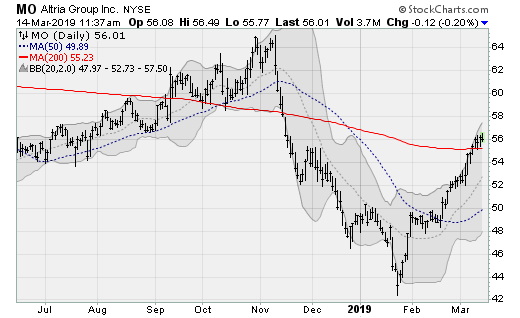
Altria Group (MO)

Shares of Altria (NYSE:MO) pay a dividend yield of 5.7%. The stock is on the move but not yet overextended: While above its 20-day and 50-day moving averages, its still below its 200-day average.

The company will next report results on April 25 before the bell. Analysts are looking for earnings of 94 cents per share on revenues of $4.6 billion. When the company last reported on January 31, earnings of 95 cents per share matches estimates on a 1.5% rise in revenues.


Compare Brokers

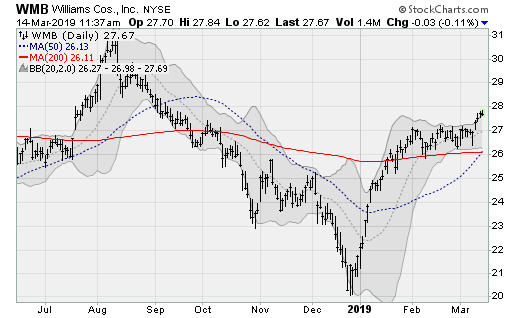
The Williams Companies (WMB)

Shares of The Williams Companies (NYSE:WMB) pay a dividend yield of 5.5%. The stock is above all three of its major moving averages, but remains 13.9% below its prior 52-week high. The energy pipeline play is well positioned to take advantage of the infrastructure shortage limiting the blitz of U.S. shale oil and gas activity.

The company will next report results on May 1 after the close. Analysts are looking for earnings of 23 cents per share on revenues of $2.3 billion. When the company last reported on February 13, earnings of 19 cents per share missed estimates by five cents.


Compare Brokers

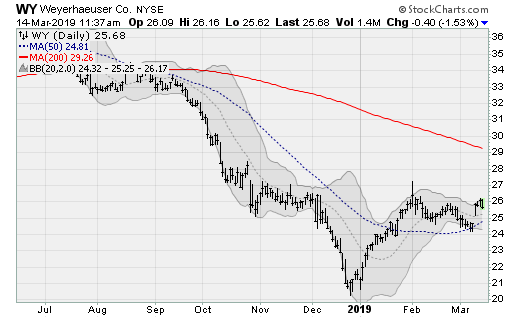
Weyerhaeuser (WY)

Weyerhaeuser (NYSE:WY) shares pay a dividend yield of 5.2%. Shares are above their 20-day and 50-day moving averages, but remain more than 14% below their 200-day average and nearly a third below the prior 52-week high. Shares recently enjoyed an upgrade by analysts at BMO Capital Markets and were initiated with a buy rating by analysts at Seaport Global Securities.

The company will next report results on April 26 before the bell. Analysts are looking for earnings of 12 cents per share on revenues of $1.7 billion. When the company last reported on February 1, earnings of 10 cents per share missed estimates by two cents on a 10.3% drop in revenues.


Compare Brokers

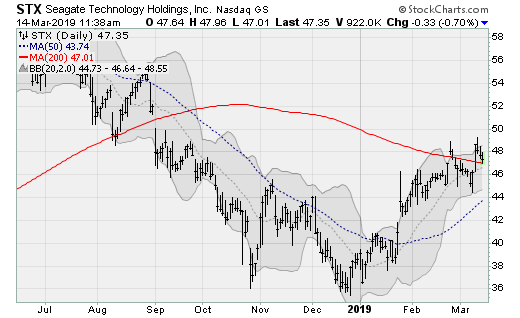
Seagate (STX)

Seagate (NASDAQ:STX) shares pay a dividend yield of 5.3%. The company is quickly closing in on its 200-day moving average. Semiconductor and memory stocks have been perking up in recent weeks on reports of lean inventories across the industry and hopes of a resurgence of demand for digital devices as global manufacturing recovers.

The company will next report results on May 1 after the close. Analysts are looking for earnings of 71 cents per share on revenues of $2.3 billion. When the company last reported on February 4, earnings of $1.41 beat estimates by 14 cents on a 6.6% drop in revenues.


Compare Brokers

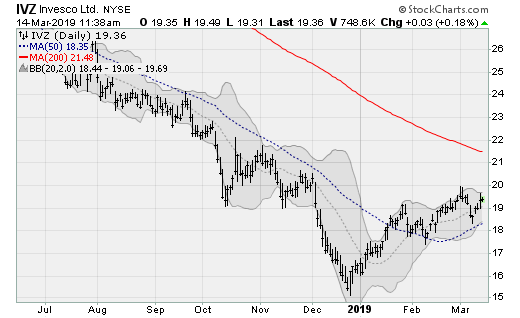
Invesco (IVZ)

Invesco (NYSE:IVZ) shares pay a dividend yield of 6.2%. Shares are above both their 20-day and 50-day moving averages, but are still more than 12% below their 200-day average and more than 40% away from their prior 52-week high. Barclays analysts recently highlighted management’s ongoing effort to find $475 million in cost savings, which would provide an earnings tailwind.

The company will next report results on April 25 before the bell. Analysts are looking for earnings of 49 cents per share on revenues of $861.5 million. When the company last reported on January 30, earnings of 44 cents per share missed estimates by 11 cents on an 8.5% drop in revenues.


Compare Brokers

Nielsen Holdings (NLSN)

Nielsen Holdings (NYSE:NLSN) shares pay a dividend yield of 5.2%. Shares are on a roll, above all three of their major moving averages as they close in on their prior 52-week high which remains 22% to the upside. The company is enjoying a lift thanks to the surge of television programming — both over-the-air, cable, and streaming — and the need for programmers to get solid audience data to make production decisions. Activist investor Elliott Management recently purchased a stake.

The company will next report results on April 25 before the bell. Analysts are looking for earnings of 32 cents per share on revenues of $1.6 billion. When the company last reported on February 28 earnings of 28 cents per share missed estimates by 27 ents on a 5.8% drop in revenues.

As of this writing, William Roth held no positions in the aforemen

Thursday, March 14, 2019

Forterra, Inc. (FRTA) Q4 2018 Earnings Conference Call Transcript

Logo of jester cap with thought bubble.

Image source: The Motley Fool.

Forterra, Inc.  (NASDAQ:FRTA)Q4 2018 Earnings Conference CallMarch 12, 2019, 10:00 a.m. ET

Contents: Prepared Remarks Questions and Answers Call Participants Prepared Remarks:

Operator

Good day, ladies and gentlemen, and welcome to the Q4 2018 Forterra, Inc Earnings Conference Call. At this time, all participants are in a listen-only mode. Following management's prepared remarks, we will host a question-and-answer session and our instructions will be given at that time. (Operator Instructions) As a reminder, today's conference call is being recorded.

It is now my pleasure to hand the conference over to Charlie Brown, Chief Financial Officer. Sir, you may begin.

Charlie Brown -- Executive Vice President and Chief Financial Officer

Thank you and good morning to everyone. Welcome to Forterra's Fourth Quarter 2018 Earnings Conference Call. Before turning the call over to Jeff, I will point out that Forterra intends to take advantage of the safe harbor provisions of the Private Securities Litigation Reform Act of 1995, as noted in the earnings release, we filed this morning.

Please remember that our comments today may include forward looking statements, which are subject to risks and uncertainties and actual results may differ materially from those indicated or implied by such statements. Some of these risks are described in detail in the Company's SEC filing, including our annual report on Form 10-K that was filed this morning. The Company does not undertake any duty to update such forward-looking statements.

Additionally, we will refer to certain non-GAAP financial measures during this call, including EBITDA, EBITDA margin, adjusted EBITDA and adjusted EBITDA margin. You can find a reconciliation of these non-GAAP financial measures to the most directly comparable GAAP measure and other related information, including discussion of why we consider these measures useful to investors in our earnings release.

Now, Jeff Bradley, our Chief Executive Officer, will give an update on our business.

Jeff Bradley -- Chief Executive Officer

Good morning, everybody, and thank you for joining us on the call this morning. Our results for the quarter and the full year reflect the progress we have made on our initiatives and strategic actions. In spite of record levels of rainfall and many of our key markets, throughout much of the year, gross margins, income from operations and adjusted EBITDA margins were all higher in the fourth quarter and the year versus fourth quarter and full year '17.

In our Drainage business, our fourth quarter results validated our continued solid execution, despite record rainfall in a number of regions. Gross profit and adjusted EBITDA in the quarter and the full year were higher as result of higher selling prices and increased cost efficiency. Our accomplishments in Drainage reflect the benefit of our strategic transactions in 2017 and early 2018, our organizational realignment, our procurement initiatives and our focus on improving the operations.

We'll continue to drive the business for further improvement this year. In the Water segment, our financial results do not reflect the progress we made last year. In response to significant increases in scrap cost throughout the year, we undertook a thorough evaluation of the business. Beginning in the second half, we made senior commercial and operational leadership changes. We talked last quarter about the benefit of higher selling frozen our bookings and backlog, and those higher prices helped to drive sequential quarter margin improvement, in spite of the seasonally slower fourth quarter. Our operational initiatives have significantly increased our productivity, and we expect further margin improvement this year.

Turning to our outlook for the Company. I'm encouraged by the end market fundamentals, starting with highway infrastructure, the largest driver in our Drainage segment. We anticipate strengthening demand based on the favorable outlook in certain key markets, including Texas, California, Colorado, Florida and the Midwest. We're seeing the benefit of improved state and local funding measures and the growing pace of lettings in the first quarter, and we anticipate continued growth in lettings for the full year.

Our positive outlook for the residential and commercial construction markets is based on conversations with our customers that support our expectations for growth this year. In addition, the National Association of Home Builders forecast reflect continued low-to-mid single digit growth in single family home starts this year and next year, in most of our key markets.

In summary, I'm encouraged about the demand outlook for the year, and we'll continue to drive improvements in the businesses. We expect another year of higher margins and earnings. Charlie?

Charlie Brown -- Executive Vice President and Chief Financial Officer

Thanks, Jeff. In the fourth quarter, we reported income from operations at $5 million and adjusted EBITDA of $33 million, which was just above the midpoint of our guidance range. One highlight, I'd like to start with, is that our team has successfully cleared all material weaknesses in internal controls. The final material weakness relating to our IT General Controls was identified in October, and due to the technical nature did require some outside assistance. These unplanned expenses caused our corporate costs to be somewhat higher than our guidance, but the remediation work is behind us and we'll now focus on driving efficiencies.

In Drainage, we delivered higher gross profit, income from operations, adjusted EBITDA and adjusted EBITDA margin through higher selling prices, to benefit our cost control initiatives and lower rent expenses. In Water, we deliver sequential quarter improvement in both our gross margin and adjusted EBITDA margin, which fell short of our guidance to match prior year's adjusted EBITDA. Significant progress in operations, increased production capacity, while commercial efforts strengthen customer alignment. Despite this progress, weather slowed shipments and as a result, we're not able to fully offset the fact that the scrap market was more than 20% above the same quarter last year.

In regards to the balance sheet, we ended the quarter with $36 million in cash. Our cash flow from operations for the year was $15 million lower than 2017, despite higher adjusted EBITDA, due primarily to an increase in our ending inventory in both our Drainage and Water segments. The inventory increase was due to weather related shipping delays, as well as strategic decision to accelerate the normal seasonal build in inventory of ductile iron pipe to support our customers.

Turning to our 2019 outlook. We expect income from operations to be in the range of $60 million to $90 million. Net loss $38 million to $16 million and adjusted EBITDA of $170 million to $200 million. Our forecast anticipates continued strong execution in Drainage and margin improvement in Water, on the benefit of higher selling prices and operational improvements. The lower end of our guidance range reflects more conservative assumptions, regarding the weather to the balance of 2019.

Our first quarter is being impacted by above the average precipitation in many of our key markets, including Texas, Florida, California, the mid-Atlantic region and the Midwest. In addition to weather, we face a tough comparison to the first quarter of last year due to high steel costs. While steel and scrap costs rose precipitously in the first quarter of 2018, the financial impact was largely deferred into the subsequent quarters, as the cost moved through inventory.

As a result, we expect that our full year forecasted growth in EBITDA will be weighted toward the back half of the year. Our earnings release posted last night also included a summary of key cash inflows and outflows highlighting the anticipated benefit of lower payments on our tax receivable agreement and positive cash flow from working capital, as we bring inventory back to more normalized levels by the end of 2019.

We're committed to making progress and improving our capital structure and plan to initiate voluntary repayment of our term loan in the range of $30 million to $85 million this year. In summary, against the backdrop of good end market demand fundamentals, we are well-positioned to deliver improved results in both our businesses. Our conversion to full year guidance reflects end market confidence, as well as progress in our forecasting and control processes. And our plan to reduce leverage reflects our intent to be a long-term leader in these markets.

That concludes our prepared remarks. Operator, will you please open the line for questions?

Questions and Answers:

Operator

My pleasure, sir. (Operator Instructions) And our first question will come from line of Rohit Seth with SunTrust. Your line is now open.

Jeff Bradley -- Chief Executive Officer

Good morning Rohit. We cannot hear you.

Operator

Alright Mr. Seth, please check your line to see if you're on mute.

Rohit Seth -- SunTrust Robinson Humphrey -- Analyst

Hey, guys, thanks for taking my question. My question is on your Water business. I'm looking at a chart with iron and scrap steel prices and your ductile to iron prices. Since you went IPO that relation has been unfavorable, it's kind of led to where you are today, on the stock. But it's finally crossed and turned positive in January. And I just want to check with you if that reflects the reality on the ground? And if so, when you think that it will start to flow through the P&L?

Jeff Bradley -- Chief Executive Officer

Hey Rohit, this is Jeff. Yes, it does reflect the reality. We expect 2019 in terms of scrap prices to be softer than last year. I don't have your chart in front of me, but I'm sure it shows accelerating price increases. So we see just really a softer year this year in scrap pricing. It typically takes 45 to 60 days for those costs to flow through our inventory.

Charlie Brown -- Executive Vice President and Chief Financial Officer

Yeah. So the prices obviously came up significantly in 2018, from end of 2017 through 2018. There may be some just that softening, but it still fairly high. And we have raised prices to offset that, and going into 2019, that is our, one of our core issues is offsetting inflation with price.

Rohit Seth -- SunTrust Robinson Humphrey -- Analyst

Where do you think the margin profile can go in the Water business? What did you assume in the guidance?

Charlie Brown -- Executive Vice President and Chief Financial Officer

We are focused on improving those, as Jeff commented on. And, I think that, yeah, and so we've delivered, we want to stay conservative as we have. But I'm certainly looking to see improvement.

Jeff Bradley -- Chief Executive Officer

As I said in my comments, we see higher margins this year for the Company versus last year.

Rohit Seth -- SunTrust Robinson Humphrey -- Analyst

I mean, is that all Drainage driven or what -- and -- can I know what other issue we're thinking about in the Water business? I think the Drainage seems fine, and you guys have delivered margins of -- recovered to where they were, when you're in an IPO largely. It's really just a sticking point on Water. The scrap been -- scraps coming off, you had your prices going up, that could be interesting. What other risks are out there?

Charlie Brown -- Executive Vice President and Chief Financial Officer

No, we agree, it will be Water improvement. Let me just first say Drainage, yes, we believe there is still opportunities for us to continue to improve Drainage. And that is going to be a focus area. But no -- when we are talking about improvement in both businesses for 2019. And Water opportunities do exist obviously, from where we have been. And looking forward, that is certainly going to benefit from the work that was completed in the second half of 2018. Again, as Jeff referenced, we made a number of management changes and brought some good new practices to bear that should be benefiting us early in 2019.

Jeff Bradley -- Chief Executive Officer

And just to piggyback on that, we're pretty excited about the operational improvements, that we've seen in the Water business, that started in the middle of last year and have continued to improve through the end of the year. We see additional improvement this year, and that's really a function of the leadership change. We talked about scrap, our backlogs are strong in both businesses. Pricing is up and the backlogs of both businesses, versus a year ago. So, those things will all lead to our optimism for this year.

Rohit Seth -- SunTrust Robinson Humphrey -- Analyst

Okay. Can you just talk me through what's assumed in the low end of the guidance?

Charlie Brown -- Executive Vice President and Chief Financial Officer

Sure, that is primarily the weather impact. It would be obviously not where we'd like to come out. But as you've seen in the past, weather is an impact on our business, we're on outdoor sport, and we have to be cognizant of that. But certainly we would expect to do better than that. And this being early in the year, we want to make sure that we give ourselves room to be able to continue to deliver within our guidance range.

Rohit Seth -- SunTrust Robinson Humphrey -- Analyst

Got you. And then last one, just on the homebuilding side of things, 40% of your business. The home builders saw order rates slow in the second half of 2018, but you're talking about increasing their community counts in 2019, which --, I think that's more relevant for you guys as you supply the pipe that goes into the infrastructure for the residential side. So can you just talk me through what you're seeing in your footprint on that front? And are you more optimistic on housing in 2019 related to what you saw in 2018?

Charlie Brown -- Executive Vice President and Chief Financial Officer

So I would just start with the fact, when we referenced 40% related to housing, that is, that is specific to the Water segment. And it's less impactful to the total Company. But the full year, the view is, as you said new neighborhood formation is probably the more important metric for our Water business than the houses themselves.

Jeff Bradley -- Chief Executive Officer

Yeah, in addition to that, I referenced the National Association of Home Builders to forecast they have there, which is low to mid-single digit growth. But we go back to our backlogs. Our backlogs are strong. Our backlogs are composed of residential, commercial, infrastructure, and that strength in backlog is across all of those segments.

Rohit Seth -- SunTrust Robinson Humphrey -- Analyst

Yeah, and on unemployment -- yeah, if you look at unemployment rates there, the strength that we have there will ultimately lead to household formation. And so we see that it looks pretty bright. Well, we've had definitely gone through a pause at the end of 2018. Our discussion with customers seems very positive going forward.

All right. Thank you.

Operator

Thank you. Our next question will come from one of Ian Zaffino with Oppenheimer. Your line is now open.

Ian Zaffino -- Oppenheimer -- Analyst

Hi. Great. Just honing in a guidance one more time. The high end -- what is that assume for weather is not perfect weather or that's you're assuming some type of other issues there?

Charlie Brown -- Executive Vice President and Chief Financial Officer

Ian, it's good to hear your voice. Yes, we're not assuming perfect weather. We're assuming more normalized weather. So obviously we'd love to do even better than that. But as you know, there will be weather in 2019, as we've already seen so far. And, we want -- as we go through the year and we see more clarity, we'll give more clarity on our range. But no, it doesn't have to be perfect weather for us to deliver.

Ian Zaffino -- Oppenheimer -- Analyst

Okay, and then...

Jeff Bradley -- Chief Executive Officer

I was just going to say, if we look at 2018, we look at the extreme events in Texas, we would have September and October, very high amounts of rain. And just to remind everybody about the business we're in, our business is the underground pipe business. So when there is heavy rain, the ground gets saturated. And it takes time for that to dry out. As another business where everything is built above ground, you don't have to wait as long for the ground to dry out. Then in the first quarter of this year, we've had heavy rains on the West Coast, the Minnesota areas had heavy snow and very, very cold. Denver's had a lot of snow in excess of what we had in the plan.

Ian Zaffino -- Oppenheimer -- Analyst

Okay. And then also as far as debt paid down, you mentioned that's going to be a big priority. What should we be assuming for the amount of debt pay down? And are we -- does not preclude any acquisitions, so we're not going to see any acquisition this year? Thanks.

Charlie Brown -- Executive Vice President and Chief Financial Officer

Sure. As the debt pay down, I mean, we're talking of $30 million to $85 million. It's really applying all of that free cash flow, that is the result of the calculations we provided. Acquisitions, we will continue to pursue acquisitions. We have talked about self-funding those through the disposal of other assets. That's really just looking at our portfolio and managing it more effectively. We have, as you know, when we did the sale leaseback arrangement, we brought back several properties which we will be able to monetize. And that funding will be applied. And, as you might have noticed in the queue, we did actually complete an acquisition in the first quarter already. We've spent about $12 million. But again, we anticipate to offset that through our disposal process.

Jeff Bradley -- Chief Executive Officer

And just add to that, Ian, the acquisitions we would be looking at and we're looking at a couple right now, are really on the smaller side. I think last quarter I talked about really looking at singles. So that's what we'll be looking at.

Ian Zaffino -- Oppenheimer -- Analyst

Okay, great. Thanks again, guys. Appreciate this.

Jeff Bradley -- Chief Executive Officer

Thanks, Ian.

Operator

Thank you. Our next question will come from line of Nishu Sood with Deutsche Bank. Your line is now open.

Timothy Daley -- Deutsche Bank -- Analyst

Hi. This is actually, Tim Daley on for Nishu. Thanks for the question. So I guess the first one is around the Water segment. I appreciate the color there. And so you mentioned that margins should improve over last year, kind of driven by the price increases along with some, I guess raw material kind of tailwind there. But how should we be thinking about the impact of price increases enacted in late 2018, should have on revenues? Were those enough that we could potentially see revenues grow on a year-over-year basis? Or should we really just kind of be keying in on that margin line?

Charlie Brown -- Executive Vice President and Chief Financial Officer

Yeah, I mean, I think we're obviously looking at the margin line because that's very important for all of us. But now, we do see growth, we see the opportunity in both the price increase and we'll increase revenue as well as the volume.

Timothy Daley -- Deutsche Bank -- Analyst

All right. That's helpful. And then I just want to clarify on a comment that was made earlier. Do you guys anticipate that there will be margin improvement in both segments on a year-over-year basis? Just given the fact that there are maybe a bit more inflationary headwinds given the building material producers seem pretty positive on their price increases, sticking in kind of the mid-single digit, high single-digit range. But they haven't really achieved over the last two years. So if you could kind of just help us understand price cost in the Drainage and how you're thinking about it in 2019? That'll be really helpful.

Charlie Brown -- Executive Vice President and Chief Financial Officer

Sure. I think the overall comment is that we are targeting, getting price to more than offset our inflationary pressures. We're certainly supportive. We saw in 2018 pretty significant increases on the steel side. We understand that some of our other suppliers are also anxious to get price increases this year. We do believe that we will be able to pass that on to our customers, and this market where demands are very high.

Jeff Bradley -- Chief Executive Officer

Just add to that, steel is a big input cost on the Drainage side, and we see steel leveling off from the level we saw last year. Somebody had mentioned a chart on scrap pricing, if I think if you laid the steel pricing -- steel cost on top of that, you would see a similar type of graph. So we see that leveling off as well.

Timothy Daley -- Deutsche Bank -- Analyst

All right. And then just the prepared remarks you guys discussed that kind of the one -- first half of the year will be a bit of a struggle given the weather, steel scrap inflation, I guess the delay in kind of that inflection point still kind of weighing on the first half the year. So how should we think about the kind of net income guidance and the earnings guidance on a quarterly basis? Should we kind of think of any negative or net losses in the first half offset with a bit or partially offset with positives in the second half or is that simply kind of maybe a 1Q event?

Charlie Brown -- Executive Vice President and Chief Financial Officer

No. I mean, I think, the first quarter is just one of the most difficult to hit, it is our least impactful quarter ever. And it is -- it comes down as Jeff said, the saturation of the ground and then the continued rain has definitely made this very uncertain. And, we're early -- we're midway through March, let's say. And this is by far our most important month in the quarter. So we really have a very hard time judging that. So I don't think there is really much of a message that we're trying to get across besides -- we've moved away from quarterly guidance, because this is a -- it's a weather impacted business. It's much more about the demand profile that we want to get across. We see very good backlogs, lettings as you know are very strong on the infrastructure side. So we're well-positioned for success in 2019. It is more the immediate impact of weather in the first quarter to worry about. And I would not say, Tim, just to address your first comment. This isn't a struggle, we're not struggling, we are definitely focused on doing the right things, as you can see, we've built some inventory as we ended the year. We'll have to move that through our system. These are all normal processes when you get impacted like we have, as year end. Hopefully, that helps.

Timothy Daley -- Deutsche Bank -- Analyst

Yeah, it does. Apologies, struggle probably wasn't the right word there. But again, thanks for the time and I appreciate the details.

Charlie Brown -- Executive Vice President and Chief Financial Officer

Appreciate the interest, Tim.

Operator

Thank you. Our next question will come the line of Matt Bouley with Barclay. Your line is now open.

Matthew Bouley -- Barclays -- Analyst

Hi. Thanks for taking my questions. I wanted to ask about that full year guide at kind of a higher level. You guys haven't given a really full year guidance. I think, since being public, Charlie, you did mention, I believe at the end of the prepared remarks, some improvement in forecasting practices. So why the change in guidance practice to that full year? I mean, I know you just mentioned weather volatility around, making it difficult on a quarterly basis. But what's giving you the confidence in kind of the longer-term visibility? And what are some of those changes you've made on the forecasting side? Thank you.

Charlie Brown -- Executive Vice President and Chief Financial Officer

Sure. I think the important thing for us is, Matt, we've demonstrated over the past year and a half that we can forecast. We can look at the quarterly and we can give you guidance that we can achieve. We wanted to transition into 2019. I think the important -- the first stage and I'm going to count that just one more time. We cleared our material weaknesses. And that talks about the back office capabilities, our ability as an organization, our financials, the robustness of that. We've spent a lot of time and energy over the past year, building that up.

So our forecasting processes have gotten better that's an important component of our business in our accounting process. So I think those are the types of things which we've looked at. And then on top of that, just, the demand area that we focus on, while we only have maybe a one quarter backlog, we spend a lot of time with our customers and we look at the longer term implications for driving their demand and that all gives us the confidence to move forward. So I think Matt, it comes down to a maturation of our capabilities as a company. So Forterra has tried to very -- tried very hard to demonstrate that ability to grow and be able to deliver as promised.

So, yes, I think that this is an important landmark for us to be able to point to -- yeah we're able to look at the full year. It does get us out of the trying to guess what's going to happen in the last few weeks of the month and gets us toward what we really see as the underlying demand, which is a story that we'd much rather talk about, because I think it's very strong and we're well positioned to take advantage of that.

Jeff Bradley -- Chief Executive Officer

Tim, in addition to that, one thing I want to mention is the strength of the management team. We have really upgraded the management team here in the corporate office and -- the corporate office and in the businesses as well. I mentioned in my comments we made leadership changes on the Water side. We've also made leadership changes on the Drainage side, and these were changes to just improve the management team to upgrade it. Same here in the corporate office.

We have today the best team and teams that we have ever had.

Matthew Bouley -- Barclays -- Analyst

Okay, I appreciate all that color. Yeah, and then I wanted to ask about the working capital side, you guided to generating cash and working capital in 2019. I think in Q4 you called out in the release and I believe in the prepared remarks that actually weather was a bit of an issue on the inventory build. But there was also a decision to accelerate the seasonal build in DIP. So could you elaborate on what was behind that decision specifically? And then just going forward, what does that mean around -- or should we expect, I guess, a greater than usual release of inventory in the first half of 2019? Thank you.

Charlie Brown -- Executive Vice President and Chief Financial Officer

Sure. So I think the build an inventory is specifically on DIP, was to address the concerns. As you may recall, this time last year, we were talking about some -- an outage in our major facility. And then throughout the whole year, we were really chasing, supplying our customers and keeping them with reasonable delivery dates. And in the third quarter I also made a comment at the end of the third quarter, that we were at operational -- effective capacity.

So it's important to note, we did not want to damage or hold back the demand from our our key customers. And thus as things slowed down at the end of the year, we made a conscious decision to build inventory. That unfortunately, that was a good thing for our customers. But as weather delayed delivery of several -- on both sides of the business, it did ramp up. And as you can see, it's almost a $50 million inventory impact on our balance sheet.

So that, that was not -- we did not plan on doing quite that much. But again, that's fine. We will move that through in 2019. And as we get your question is what the impact would be in the first half? As we bring that inventory down, we get ready for really Q3, which is our biggest quarter, as you know. And that we need to have make sure that we have good inventory on hand, because we cannot actually produce in the quarter, exactly what we need. We actually have to build up.

So we may still be a little bit high at the end of Q2. But as we go through Q3 and finish the year at Q4, we do believe, as indicated, that we'd bring this down $30 million to $50 million, and that offsets really what we've built for 2018 year end.

Matthew Bouley -- Barclays -- Analyst

Got it. Appreciate those details. Thanks again.

Jeff Bradley -- Chief Executive Officer

Of course.

Operator

Thank you. And our next question comes from line of Jerry Revich with Goldman Sachs. Your line is now open.

Benjamin Burud -- Goldman Sachs -- Analyst

Good morning, everyone. This is Ben Burud on for Jerry. Just wanted to start on, how end market demand is shaping up into 2Q? I appreciate that, obviously weather has been a big headwind, in 1Q and it's your seasonally weakest quarter. But, as we wrap up March here, can you kind of give us an idea how the pricing environment, how end demand is shaping up as we ramp into construction season?

Jeff Bradley -- Chief Executive Officer

Sure Matt, -- Ben, this is Jeff. We track our backlogs every single week. We update them. And as I have mentioned, our backlogs in both businesses are strong. Overall if you look at the company backlog, volume is up and backlog prices up. So that really gives us the confidence going into 2Q, that we share and really the confidence that we've shared about the back half of this year -- so it looks good.

Charlie Brown -- Executive Vice President and Chief Financial Officer

Yeah and I think it's both that is volume and price and those are important components for delivering the results we talked about.

Benjamin Burud -- Goldman Sachs -- Analyst

Got it. And then on the cost inflation side of things, can you give us an idea of what you're seeing, if any, on labor inflation and also on the freight side? Can you give us an update there? Spot rates start to tail-off versus strong 2018?

Jeff Bradley -- Chief Executive Officer

Sure, labor -- on the labor side, we see some inflation on the labor side, but we've got some great things going on -- on the operations side, to really take some of that labor cost out. We're seeing good results, last year where we continue to drive those results this year, so we're excited about all of that.

Charlie Brown -- Executive Vice President and Chief Financial Officer

Yeah, and I think, as freight is going to continue to be, it's important to us. We think that there is several things that we can do to improve that in 2019, not only will the rates start to fall, which we've seen. But also through efficiencies, we have been able to move some product, last year we had two truck. We should be able to have rail. We have railed into those markets. So with more efficient delivery, taking advantage of that benefit as well.

So I think there is good upside on both of those things. And as Jeff said, labor, while the rates will go up, we do need to pay our employees, because the employment situation is very tough. But right now that's been improved, I think Rich Hunter has done a wonderful job, our Chief Operating Officer has come in and looked at a lot of our processes and tried to take -- make those labor improvements that will offset the cost increases.

Benjamin Burud -- Goldman Sachs -- Analyst

Got it. Thank you.

Charlie Brown -- Executive Vice President and Chief Financial Officer

Thank you, Ben.

Operator

Thank you. (Operator Instructions) Our next question will come from the line of Scott Schrier with Citi. Your line is now open.

Scott Schrier -- Citigroup -- Analyst

Hi, good morning.

Charlie Brown -- Executive Vice President and Chief Financial Officer

Hi, Scott.

Scott Schrier -- Citigroup -- Analyst

And Charlie, earlier you acknowledged that the aggs and cement players seem to be more aggressive in pushing price, something maybe they weren't able to get a lot of price in the past couple of years. You talked about, that you are raising price and you do expect margins to increase, but I'm curious as we think about incrementals and operating leverage in Drainage. Do you still -- do you expect it to be challenging? Or do you think that the pieces are in place to see a favorable operating leverage or incremental kind of number for 2019? And then just if I'm thinking about longer-term, how do you view the potential for operating leverage in the Drainage business?

Jeff Bradley -- Chief Executive Officer

Yes, Thanks. It's a good question. We work closely with all of our suppliers, let say on the aggregate, the cement. I mean, we're a large consumer, not the largest, but we're a significant player and we do have good relationships with these suppliers. We will work closely with them to make sure that we get the best prices we possibly can from them. But at the same time, we will be able to pass that on. We feel good about being able to pass that on. I think there is an important component of this, the market is -- the demands is there. So that costs will be going up for everybody. We should be able to take advantage of that, I mean getting the ASP or Average Selling Prices up to offset that.

And I do think the other improvements that we make will allow us to pull margins through. But I would make the point, Scott, that none of this was easy. This is -- this will take a lot of work, it's -- as Jeff talked about the team, we have a very good team focused on, and achieving this. You don't get price without working damn hard to get it. And we're willing to do that and see that -- it will yield good margin improvement for us as we go forward.

We did -- Scott we really -- great job last year bringing in Rich Hunter as CLO on the Water side. He spent an awful lot of his time in the business and we saw great operational efficiency improvements as we went through the second half of the year. He is continuing to work with his team and drive those improvements on the Water side. But this year, he is also put together a fantastic team on the Drainage side, and we see a lot of opportunity there to drive additional operating efficiencies, which going to impact our cost.

Scott Schrier -- Citigroup -- Analyst

Great. And then I want to reconcile some of the comments and discussions about the back half weighting. But, you do have your backlog now, it's up year-on-year. So I'm wondering if -- you talked about lettings and we've seen public lettings over the past 15 months, be up significantly. And then we look at some of the labor data for highway bridge contractors, actually has looked good. So I'm curious if, do we expect obviously weather aside that April, May and June that this stuff will be rolling through and that we could see a lot of strength in some of these end markets in the spring? Or do we have to wait until the summer and beyond, before you really start to see a lot of that roll through?

Charlie Brown -- Executive Vice President and Chief Financial Officer

Yeah, I think we're optimistic about the spring, again I hate to keep talking about the weather and rain. Spring is usually when we have a lot of rain. But in this past year, we've had rain throughout the whole year. But we're optimistic about the second quarter and the second half of the year. Our backlogs are strong, as I said, the contractors need to get back to work. I mean, we still have seen here in Texas, there are job sites that they haven't been able to get through for months because the ground is just saturated. So they're as anxious to get back to work as we are to ship product. So, pent up demand, pent up waters, lettings are strong. We're feeling good.

Scott Schrier -- Citigroup -- Analyst

And one last one, in the press release you made some comments, on some softness in Canadian concrete pressure pipe having an impact on the Water business. I'm wondering if you could talk a little bit about what you're seeing there and what we could expect to happen there during 2019?

Charlie Brown -- Executive Vice President and Chief Financial Officer

Yeah. Scott that just -- it is a very small part of our business, but it just slipped. And again, it comes down to just the projects that water, pressure pipe, which as you recall, we exited in the US and it is more of a lumpy business. So it tends to have some ups and downs. And this was just down for us. It's very large diameter product, where we don't play much at all, and there wasn't much work. So it was much more focused on certain other aspects, which are lower margin in that specific business segment. But again, not a significant thing, it'll be pluses and minuses. And we'll be able to throw that comment in, as necessary going forward.

Scott Schrier -- Citigroup -- Analyst

Thanks for taking the questions and good luck.

Jeff Bradley -- Chief Executive Officer

Thanks, Scott.

Operator

Thank you. And our next question will come from Andrew Casella with Deutsche Bank. Your line is now open.

Andrew Casella -- Deutsche Bank -- Analyst

Hey guys, thanks for taking my questions. Just actually just one, just on the debt repayment. When we think about the implementation there, is it your view that you will go into the open market to kind of capture some of the discount on your term loan, I know it's kind of trading around that $93 million, $94 (ph) million context, or would these all be part paydowns as you guys kind of think about attacking that maturity?

Charlie Brown -- Executive Vice President and Chief Financial Officer

Yes, that is exactly how we plan on going out at it Andrew.

Andrew Casella -- Deutsche Bank -- Analyst

It's about , which one is it, both of them or the latter?

Charlie Brown -- Executive Vice President and Chief Financial Officer

We'll be buying it in the market.

Andrew Casella -- Deutsche Bank -- Analyst

Okay. All right. Thanks so much.

Operator

Thank you. And I'm showing no further questions at this time. So now it is my pleasure to hand the conference back over to Jeff Bradley, Chief Executive Officer for any closing comments or remarks.

Jeff Bradley -- Chief Executive Officer

Thank you, everybody. We really appreciate your interest. We look forward to talking to you to the balance of the year. Thank you.

Operator

Ladies and gentlemen, thank you for your participation on today's conference. This does conclude our program and we may all disconnect. Everybody have a wonderful day.

Duration: 39 minutes

Call participants:

Charlie Brown -- Executive Vice President and Chief Financial Officer

Jeff Bradley -- Chief Executive Officer

Rohit Seth -- SunTrust Robinson Humphrey -- Analyst

Ian Zaffino -- Oppenheimer -- Analyst

Timothy Daley -- Deutsche Bank -- Analyst

Matthew Bouley -- Barclays -- Analyst

Benjamin Burud -- Goldman Sachs -- Analyst

Scott Schrier -- Citigroup -- Analyst

Andrew Casella -- Deutsche Bank -- Analyst

More FRTA analysis

Transcript powered by AlphaStreet

This article is a transcript of this conference call produced for The Motley Fool. While we strive for our Foolish Best, there may be errors, omissions, or inaccuracies in this transcript. As with all our articles, The Motley Fool does not assume any responsibility for your use of this content, and we strongly encourage you to do your own research, including listening to the call yourself and reading the company's SEC filings. Please see our Terms and Conditions for additional details, including our Obligatory Capitalized Disclaimers of Liability.

Wednesday, March 13, 2019

Insider Selling: Lincoln Electric Holdings, Inc. (LECO) Director Sells 2,531 Shares of Stock

Lincoln Electric Holdings, Inc. (NASDAQ:LECO) Director Hellene S. Runtagh sold 2,531 shares of the stock in a transaction on Friday, March 8th. The shares were sold at an average price of $84.23, for a total value of $213,186.13. Following the sale, the director now owns 24,878 shares in the company, valued at $2,095,473.94. The sale was disclosed in a document filed with the SEC, which is available at this hyperlink.

Shares of LECO stock traded down $0.21 on Tuesday, reaching $85.20. The stock had a trading volume of 222,848 shares, compared to its average volume of 309,144. The company has a market cap of $5.44 billion, a P/E ratio of 17.68, a price-to-earnings-growth ratio of 1.35 and a beta of 1.23. Lincoln Electric Holdings, Inc. has a 1 year low of $72.28 and a 1 year high of $97.93. The company has a debt-to-equity ratio of 0.75, a current ratio of 2.58 and a quick ratio of 1.88.

Get Lincoln Electric alerts:

Lincoln Electric (NASDAQ:LECO) last released its quarterly earnings results on Thursday, February 14th. The industrial products company reported $1.29 earnings per share (EPS) for the quarter, topping the Zacks’ consensus estimate of $1.20 by $0.09. The firm had revenue of $744.00 million for the quarter, compared to the consensus estimate of $763.57 million. Lincoln Electric had a return on equity of 33.31% and a net margin of 9.48%. The company’s revenue for the quarter was down .4% on a year-over-year basis. During the same period last year, the business posted $1.01 EPS. As a group, analysts expect that Lincoln Electric Holdings, Inc. will post 5.3 earnings per share for the current year.

The business also recently announced a quarterly dividend, which will be paid on Monday, April 15th. Investors of record on Friday, March 29th will be issued a $0.47 dividend. The ex-dividend date of this dividend is Thursday, March 28th. This represents a $1.88 dividend on an annualized basis and a yield of 2.21%. Lincoln Electric’s dividend payout ratio is currently 39.00%.

A number of institutional investors have recently made changes to their positions in LECO. Bank of New York Mellon Corp grew its stake in shares of Lincoln Electric by 0.3% in the 2nd quarter. Bank of New York Mellon Corp now owns 826,788 shares of the industrial products company’s stock valued at $72,558,000 after buying an additional 2,216 shares during the period. Victory Capital Management Inc. grew its stake in shares of Lincoln Electric by 14.0% in the 3rd quarter. Victory Capital Management Inc. now owns 43,251 shares of the industrial products company’s stock valued at $4,041,000 after buying an additional 5,298 shares during the period. Wells Fargo & Company MN grew its stake in shares of Lincoln Electric by 7.8% in the 3rd quarter. Wells Fargo & Company MN now owns 153,270 shares of the industrial products company’s stock valued at $14,322,000 after buying an additional 11,108 shares during the period. WINTON GROUP Ltd purchased a new stake in shares of Lincoln Electric in the 3rd quarter valued at approximately $201,000. Finally, Los Angeles Capital Management & Equity Research Inc. grew its stake in shares of Lincoln Electric by 10.3% in the 3rd quarter. Los Angeles Capital Management & Equity Research Inc. now owns 105,082 shares of the industrial products company’s stock valued at $9,819,000 after buying an additional 9,780 shares during the period. 71.21% of the stock is currently owned by institutional investors.

Several analysts have commented on LECO shares. BidaskClub downgraded Lincoln Electric from a “hold” rating to a “sell” rating in a research note on Wednesday, November 21st. Zacks Investment Research upgraded Lincoln Electric from a “sell” rating to a “hold” rating in a research note on Wednesday, January 2nd. Jefferies Financial Group assumed coverage on Lincoln Electric in a research note on Friday, January 25th. They issued a “buy” rating and a $100.00 price target on the stock. Vertical Research downgraded Lincoln Electric from a “hold” rating to a “sell” rating and set a $80.00 price target on the stock. in a research note on Friday, February 15th. Finally, Wellington Shields downgraded Lincoln Electric from a “gradually accumulate” rating to a “hold” rating and set a $97.00 price target on the stock. in a research note on Friday, February 15th. One equities research analyst has rated the stock with a sell rating, six have issued a hold rating and five have assigned a buy rating to the company’s stock. The company presently has an average rating of “Hold” and an average target price of $96.00.

TRADEMARK VIOLATION NOTICE: “Insider Selling: Lincoln Electric Holdings, Inc. (LECO) Director Sells 2,531 Shares of Stock” was originally posted by Ticker Report and is owned by of Ticker Report. If you are viewing this article on another publication, it was illegally stolen and republished in violation of United States and international copyright and trademark legislation. The correct version of this article can be read at https://www.tickerreport.com/banking-finance/4216468/insider-selling-lincoln-electric-holdings-inc-leco-director-sells-2531-shares-of-stock.html.

Lincoln Electric Company Profile

Lincoln Electric Holdings, Inc engages in the manufacture of arc welding equipment, consumable welding products and other welding and cutting products. Its welding products include arc welding power sources, wire feeding systems, robotic welding packages, fume extraction equipment, consumable electrodes and fluxes.

Featured Story: Momentum Investing

Tuesday, March 12, 2019

Acadian Asset Management LLC Takes $341,000 Position in Sandy Spring Bancorp Inc. (SASR)

Acadian Asset Management LLC bought a new stake in Sandy Spring Bancorp Inc. (NASDAQ:SASR) during the 4th quarter, Holdings Channel reports. The institutional investor bought 10,892 shares of the bank’s stock, valued at approximately $341,000.

Several other large investors have also recently modified their holdings of the company. Dimensional Fund Advisors LP boosted its stake in shares of Sandy Spring Bancorp by 6.1% in the 3rd quarter. Dimensional Fund Advisors LP now owns 2,383,316 shares of the bank’s stock valued at $93,688,000 after purchasing an additional 137,735 shares in the last quarter. Vanguard Group Inc. boosted its stake in shares of Sandy Spring Bancorp by 2.7% in the 3rd quarter. Vanguard Group Inc. now owns 1,645,043 shares of the bank’s stock valued at $64,666,000 after purchasing an additional 43,886 shares in the last quarter. Vanguard Group Inc boosted its stake in shares of Sandy Spring Bancorp by 2.7% in the 3rd quarter. Vanguard Group Inc now owns 1,645,043 shares of the bank’s stock valued at $64,666,000 after purchasing an additional 43,886 shares in the last quarter. Renaissance Technologies LLC boosted its stake in shares of Sandy Spring Bancorp by 2.9% in the 3rd quarter. Renaissance Technologies LLC now owns 956,210 shares of the bank’s stock valued at $37,589,000 after purchasing an additional 26,500 shares in the last quarter. Finally, Alliancebernstein L.P. boosted its stake in shares of Sandy Spring Bancorp by 53.0% in the 3rd quarter. Alliancebernstein L.P. now owns 841,736 shares of the bank’s stock valued at $33,089,000 after purchasing an additional 291,680 shares in the last quarter. Institutional investors own 69.04% of the company’s stock.

Get Sandy Spring Bancorp alerts:

Sandy Spring Bancorp stock opened at $33.05 on Friday. The company has a debt-to-equity ratio of 0.87, a current ratio of 1.06 and a quick ratio of 1.06. Sandy Spring Bancorp Inc. has a 12-month low of $29.87 and a 12-month high of $43.87. The stock has a market capitalization of $1.24 billion, a P/E ratio of 11.56 and a beta of 0.72.

Sandy Spring Bancorp (NASDAQ:SASR) last released its quarterly earnings results on Thursday, January 17th. The bank reported $0.72 earnings per share (EPS) for the quarter, missing the Zacks’ consensus estimate of $0.79 by ($0.07). Sandy Spring Bancorp had a net margin of 26.19% and a return on equity of 10.10%. The business had revenue of $80.18 million during the quarter, compared to the consensus estimate of $81.94 million. During the same period in the prior year, the firm earned $0.34 earnings per share. As a group, sell-side analysts predict that Sandy Spring Bancorp Inc. will post 3.14 EPS for the current fiscal year.

The firm also recently declared a quarterly dividend, which was paid on Wednesday, February 20th. Investors of record on Wednesday, February 13th were issued a $0.28 dividend. The ex-dividend date of this dividend was Tuesday, February 12th. This represents a $1.12 dividend on an annualized basis and a dividend yield of 3.39%. Sandy Spring Bancorp’s dividend payout ratio is 39.16%.

In other Sandy Spring Bancorp news, Director Mark E. Friis purchased 1,000 shares of the business’s stock in a transaction that occurred on Tuesday, January 22nd. The stock was acquired at an average cost of $31.86 per share, with a total value of $31,860.00. Following the completion of the acquisition, the director now directly owns 11,235 shares of the company’s stock, valued at approximately $357,947.10. The transaction was disclosed in a document filed with the Securities & Exchange Commission, which is available through the SEC website. Also, EVP Ronda M. Mcdowell sold 744 shares of Sandy Spring Bancorp stock in a transaction dated Wednesday, February 27th. The shares were sold at an average price of $35.02, for a total value of $26,054.88. Following the completion of the transaction, the executive vice president now directly owns 6,034 shares of the company’s stock, valued at $211,310.68. The disclosure for this sale can be found here. Insiders own 3.31% of the company’s stock.

SASR has been the topic of several recent analyst reports. BidaskClub downgraded shares of Sandy Spring Bancorp from a “hold” rating to a “sell” rating in a research note on Tuesday, January 22nd. Gabelli reaffirmed a “buy” rating on shares of Sandy Spring Bancorp in a report on Friday, January 18th. Zacks Investment Research cut Sandy Spring Bancorp from a “hold” rating to a “sell” rating in a report on Thursday, December 20th. Sandler O’Neill cut Sandy Spring Bancorp from a “buy” rating to a “hold” rating and set a $35.00 price target for the company. in a report on Friday, January 18th. Finally, Keefe, Bruyette & Woods cut Sandy Spring Bancorp from an “outperform” rating to a “market perform” rating and cut their price target for the company from $44.00 to $35.00 in a report on Friday, January 18th. One equities research analyst has rated the stock with a sell rating, four have issued a hold rating and three have issued a buy rating to the stock. The stock currently has a consensus rating of “Hold” and an average price target of $40.00.

ILLEGAL ACTIVITY WARNING: This news story was first reported by Ticker Report and is owned by of Ticker Report. If you are reading this news story on another site, it was illegally stolen and reposted in violation of US and international trademark & copyright law. The correct version of this news story can be accessed at https://www.tickerreport.com/banking-finance/4208288/acadian-asset-management-llc-takes-341000-position-in-sandy-spring-bancorp-inc-sasr.html.

Sandy Spring Bancorp Profile

Sandy Spring Bancorp, Inc operates as the bank holding company for Sandy Spring Bank that provides commercial banking services to individuals and businesses in central Maryland, Northern Virginia, and Washington DC markets. It operates through three segments: Community Banking, Insurance, and Investment Management.

Further Reading: Analyzing a company's cash flow statement

Want to see what other hedge funds are holding SASR? Visit HoldingsChannel.com to get the latest 13F filings and insider trades for Sandy Spring Bancorp Inc. (NASDAQ:SASR).

Institutional Ownership by Quarter for Sandy Spring Bancorp (NASDAQ:SASR)

Saturday, March 9, 2019

SoftBank CEO: AI will completely change the way humans live within 30 years

People should brace themselves for the proliferation of artificial intelligence as it will change the way we live within three decades, according to SoftBank CEO Masayoshi Son.

"Within 30 years, definitely, things will be flying," Son, who goes by the nickname "Masa," told CNBC's David Faber in an interview that aired Friday. "Things will be running much faster without accident. We will be living much longer, much healthier. The diseases that we could not solve in the past will be cured."

Son has long championed the benefits of artificial intelligence, investing billions of dollars in companies he believes can capitalize on it. Some of these companies, according to him, include Uber Technologies and WeWork. He said all the 70 or so investments of his Vision Fund have been focused on AI.

"That's the only one thing" he's focused on, Son said. " We are investing $100 billion in just one thing, AI."

Uber is an example of a company that will transform the way humans move around, he said. "Today we are driving ourselves," he said. "That would no longer be the case. "AI would make the transportation to cause zero accidents."

However, some have cautioned against the proliferation of AI.

Renowned physicist Stephen Hawking said before his death last year that the emergence of AI could be "worst event in the history of our civilization," noting it could lead to the creation of autonomous weapons. Tesla CEO Elon Musk, meanwhile, said in 2017 that AI could bring about the third World War.

Others argue that greater artificial intelligence could lead to job losses. But Son is not too worried.

"I'm [an] optimist, OK. There will be always be an issue… but mankind is smart enough. We always try to adapt to the new situation."

show chapters What is Softbank? What is Softbank?    7:00 AM ET Tue, 19 Feb 2019 | 03:51

Subscribe to CNBC on YouTube.

Friday, March 8, 2019

Lent is Filet-O-Fish season at McDonald's

Lent and seafood go hand in fin.

And McDonald's Filet-O-Fish, a 54-year fixture, is one of the most popular menu items, especially on the Fridays leading up to Easter, a time when many Catholics forgo meat.

According to McDonald's, the sandwich dates to 1962 when Lou Groen, who owned the first McDonald's restaurant in Cincinnati, came up with the idea. Groen's restaurant was in a predominantly Roman Catholic neighborhood, and he noticed a decrease in sales on Fridays.

In 1965, the Filet-O-Fish was the first addition to McDonald's original menu and was the only non-hamburger option at the time.

"The Filet-O-Fish has become a popular menu item enjoyed by millions of customers around the world," said McDonald's Company Historian Mike Bullington in a 2016 blog post.

CLOSE

Lent is a time for prayer and self-examination, but fasting doesn't have to mean going hungry. Here's some options for the modern Christian. Wochit

Fish-fil-A?: Chick-fil-A serves up fish sandwiches for Lent, now through April 20

March freebies: Your monthly guide to food specials, meal deals and more

McDonald's says it uses solely Marine Stewardship Council (MSC)-certified wild-caught Alaska Pollock for its Filet-O-Fish sandwiches sold at its U.S. locations.

In 2016, the company said it sells nearly 25 percent of its fish sandwiches during the Lenten Season.

While the Filet-O-Fish is available all year at all U.S. McDonald's, other fast-food chains and restaurants add more seasonal seafood options to their menus for Lent.

On Wednesday, Chick-fil-A announced the return of its Fish Sandwich, which is available through April 20, the day before Easter, at participating restaurants.

Follow Kelly Tyko on Twitter: @KellyTyko

Thursday, March 7, 2019

Why CoStar Group Stock Popped 17% in February

What happened

Shares of CoStar Group (NASDAQ:CSGP) climbed 17.1% last month, according to data provided by S&P Global Market Intelligence, after the real estate information provider delivered a strong fourth-quarter report and issued upbeat guidance for the year ahead.

So what

CoStar Group's fourth-quarter revenue jumped 24% to $316 million. Profit growth was even more impressive: Net income surged 89% to $84 million, while adjusted net income soared 126% to $102 million. 

CoStar is enjoying solid growth across all of its major business segments. Its CoStar Suite information product saw revenue rise 16% to $142 million. Meanwhile, sales in its multifamily marketplace business leapt 44% to $109 million, driven by the strong growth of Apartments.com. 

Additionally, CEO Andrew Florance said during a conference call with analysts that the company believes it can more than triple revenue at its LoopNet commercial real estate marketplace in the coming years.  

Rising orange stock chart on blue background

Image source: Getty Images.

Now what

CoStar Group expects companywide revenue to rise another 15% to approximately $1.38 billion in 2019. Management is also guiding for adjusted earnings to increase by as much as 21% to $10 per share. 

Looking even further ahead, Florance said that CoStar Group is targeting a $3 billion revenue run rate by the end of 2023. That would represent a near-tripling of the $1.2 billion in revenue the company generated in 2018.

All told, CoStar Group's shares are now up almost 35% so far in 2019, but if Florance and his team can deliver on their aggressive growth targets, more gains could still lie ahead for investors.

Why Dollar Tree Stock Rose Today

What happened

Shares of Dollar Tree (NASDAQ:DLTR) moved higher today after the discount retailer posted better-than-expected fourth-quarter results and said it would close hundreds of Family Dollar locations, as that brand has struggled since Dollar Tree acquired it in 2015. The company took a $2.7 billion goodwill impairment charge in the quarter on Family Dollar, showing it hasn't met expectations.  

The stock closed up 5.1% on the news.

So what 

In the fourth quarter, Dollar Tree said overall comparable sales rose 2.4%, with the key metric up 3.2% at Dollar Tree locations and 1.4% at Family Dollar. Overall revenue fell 2.4% to $6.21 billion as the company had one fewer week in the quarter, but that still beat estimates of $6.19 billion.

A woman shopping next to Christmas decorations.

Image source: Getty Images.

Gross margin declined 220 basis points to 30.8% due to higher markdowns, a reduction in stock-keeping units at Family Dollar, and other costs. Adjusted earnings per share (EPS) still rose, however, due to a lower tax rate, increasing from $1.89 to $1.93, matching estimates.

CEO Gary Philbin said, "Our results demonstrate the increasing strength of the Dollar Tree brand, and accelerated progress on the Family Dollar turnaround, as Family Dollar delivered its strongest quarterly same-store sales growth of the year."

The big news in the report seemed to be that Dollar Tree would accelerate its transformation plans for Family Dollar; it closed 84 stores in the fourth quarter and announced plans to renovate at least 1,000 stores in 2019. Those plans include adding $1.00 Dollar Tree merchandise sections to those stores, "re-bannering" 200 locations as Dollar Tree stores, and separately closing 390 Family Dollar locations.

Now what 

Investors seemed to cheer the Family Dollar store closures as the brand has long been a thorn in the Dollar Tree's side. In its outlook for 2019, the company projected low-single-digit comparable sales growth and total revenue of $23.45 billion to $23.87 billion, up from $22.8 billion in 2018. On the bottom line, it called for adjusted EPS of $5.16 to $5.56, compared to $5.45 last year.

While that guidance indicates that challenges remain, today's results and the store renovation and closing plan were enough to show investors that Dollar Tree is moving in the right direction.


Wednesday, March 6, 2019

Stocks in the news: Wipro, Blue Star, Endurance Tech, Jubilant Life, Quick Heal, Edelweiss

Here are stocks that are in the news today:

Bharti Airtel: Airtel collaborates with Zoom to launch India's first high quality unified communications solution for businesses' issued by the company.

Karur Vysya Bank: Capital Raising Committee approved the information memorandum in relation to issue of BASEL III compliant Unsecured Non-convertible Tier II Bonds in the nature of debenture of Rs 1,00,000 each for a total approved borrowing programme of Rs 1,200 crore in one of more Tranches with present 'Tranche A' of Rs 300 crore with green shoe option of upto Rs 300 crore aggregating upto Rs 600 crore.

Newgen Software: Company receives patents from Indian Patent Office for its inventions.

related news Stocks in the news: Jet Airways, RIL, Indian Hume Pipe, IRB Infra, Hero Moto, Aurobindo, Tata Motors Stocks in the news: Bharti Airtel, DHFL, ABB India, Jet Airways, Infosys, Forbes & Company Stocks in the news: Wipro, Bharti Airtel, Quick Heal, Vascon Engineers, Quess Corp, KSB

Reserve Bank of India (RBI) imposed penalty of Rs 2 crore on Bank of Maharashtra

Grasim Industries signed a definitive agreement, to acquire 100% equity shareholding of Soktas India, from its current promoters, for an enterprise value of Rs 165 crore

Edelweiss Financial Services: CDPQ Private Equity Asia Pte Ltd, the subsidiary of North America-based pension fund manager, to invest over Rs 1,800 crore in ECL Finance Limited, the non-banking financial company (NBFC) arm of Edelweiss Group.

Bosch: Company announced an extinguishment of equity shares with respect to the buyback of 10,27,100 fully paid-up equity shares of face value of Rs 10 each.

Quick Heal Technologies: Board approved a proposal to buyback up to 63,63,636 equity shares of the company, being 9.02 percent of the total paid up equity, for an aggregate amount not exceeding Rs 175 crore, at a price of Rs 275 per share.

Jubilant Life Sciences: Subsidiary Jubilant Pharma (incorporated under the laws of Singapore) successfully completed the issuance of rated unsecured bonds (to institutional investors outside India. The Notes were issued at par in a principal amount of $200 million and will mature in March, 2024.

Endurance Technologies: Promoter Anurag Jain to sell up to 63,63,637 equity shares (representing 4.52 percent of the paid up equity) on March 6 and March 7 with an option to additionally sell up to 41,89,051 equity shares (representing 2.98 percent of the paid up equity) through Offer for Sale route.

Blue Star: Board appointed Shailesh Haribhakti, Independent Director as the Chairman, elevated Vir S Advani as Vice Chairman and his re-designation as Vice Chairman & Managing Director, and elevated B Thiagarajan to Managing Director of the company.

The Investment Trust of India: Subsidiary ITI Alternate Funds Management Limited received a registration certificate from SEBI to act as Portfolio Manager.

Avenue Supermarts: Company issued commercial paper of Rs 50 crore.

Wipro: Stock will trade ex-bonus (1:3) from March 6. Revised market lot for Futures & Options contracts would be 3,200.

Sterlite Technologies: Company unveils TruRibbonTM - Ribbon Reinvented, a fully backward compatible cable built for high-capacity networks.

Bulk Deals on March 05

NSE

CESC Ventures: International New Discovery Fund sold 1,48,126 shares of the company at Rs 516.44 per share.

J Kumar Infraprojects: Capri Global Holdings Private Limited bought 4,50,000 shares of the company at Rs 148 per share.

PG Electroplast: Swing Infraspace Private Limited sold 94,705 shares of the company at Rs 78.61 per share.

SP Apparels: Edelweiss Multi Strategy Funds Management Pvt Ltd - Hexagon sold 1,68,205 shares of the company at Rs 253.22 per share.

Shalimar Paints: Meenakshi Gupta sold 4,78,900 shares of the company at Rs 65.22 per share.

Shree Pushkar Chemicals: Edelweiss Multi Strategy Funds Management Pvt Ltd - Hexagon sold 1,55,026 shares of the company at Rs 130.14 per share.

Spencer: MFS Emerging Markets Equity Fund sold 5,75,830 shares of the company at Rs 150.1 per share.

Surani Steel Tubes: Satyanarayan Jagannath Kabra sold 50,000 shares of the company at Rs 53.9 per share.

BSE

La Opala RG: Steadview Capital Mauritius Limited sold 7,53,715 shares of the company at Rs 200 per share.

(For more bulk deals, click here)

Analyst or Board Meet/Briefings

Arcotech: Extra-Ordinary general meeting to be held on March 29.

Cipla: Company's officials will meet Matthews India Fund, San Francisco on March 6 in Mumbai.

Sun TV Network: Board meeting is scheduled on March 8 to consider interim dividend if any, for the financial year 2018-19.

Mahindra & Mahindra: Company's officials will meet Aditya Birla Money on March 7, Quest Investment Advisors on March 13 and Janus Henderson on March 14 in Mumbai.

Jubilant Life Sciences: Management of the company will be meeting investor/ analysts in Mumbai on March 6.

Indostar Capital Finance: Company's officials will attend Prabhudas Liladhar Investor Conference on March 7, in Mumbai.

Tata Metaliks: Company's officials will meet Investors/ Analysts on March 6.

Lakshmi Vilas Bank: Board meeting is scheduled on March 8 to consider the raising of funds by way of issue of equity shares of the bank on preferential basis.

HUDCO: Board meeting is proposed to be held on March 12 to consider payment of interim dividend for the financial year 2018-19.

SREI Infrastructure Finance: Board will consider declaration of interim dividend on March 8. The record date is fixed as March 16.

KSB: Company's officials will attend investor conference on March 6.

ACC: Company's officials will meet Nomura Asset Management(Singapore) on March 6.

Titan Company: Company's officials will meet JPMorgan Asset Management (UK) Ltd & Blackrock International on March 6, and Nomura Asset Management on March 8.

NLC India: Board meeting is scheduled to be held on March 18 to consider declaration of interim dividend, if any, for the financial year 2018-19.

Pidilite Industries: Company's officials will meet JP Morgan Asset Management on March 8 and Axis Asset Management on March 11. First Published on Mar 6, 2019 07:46 am